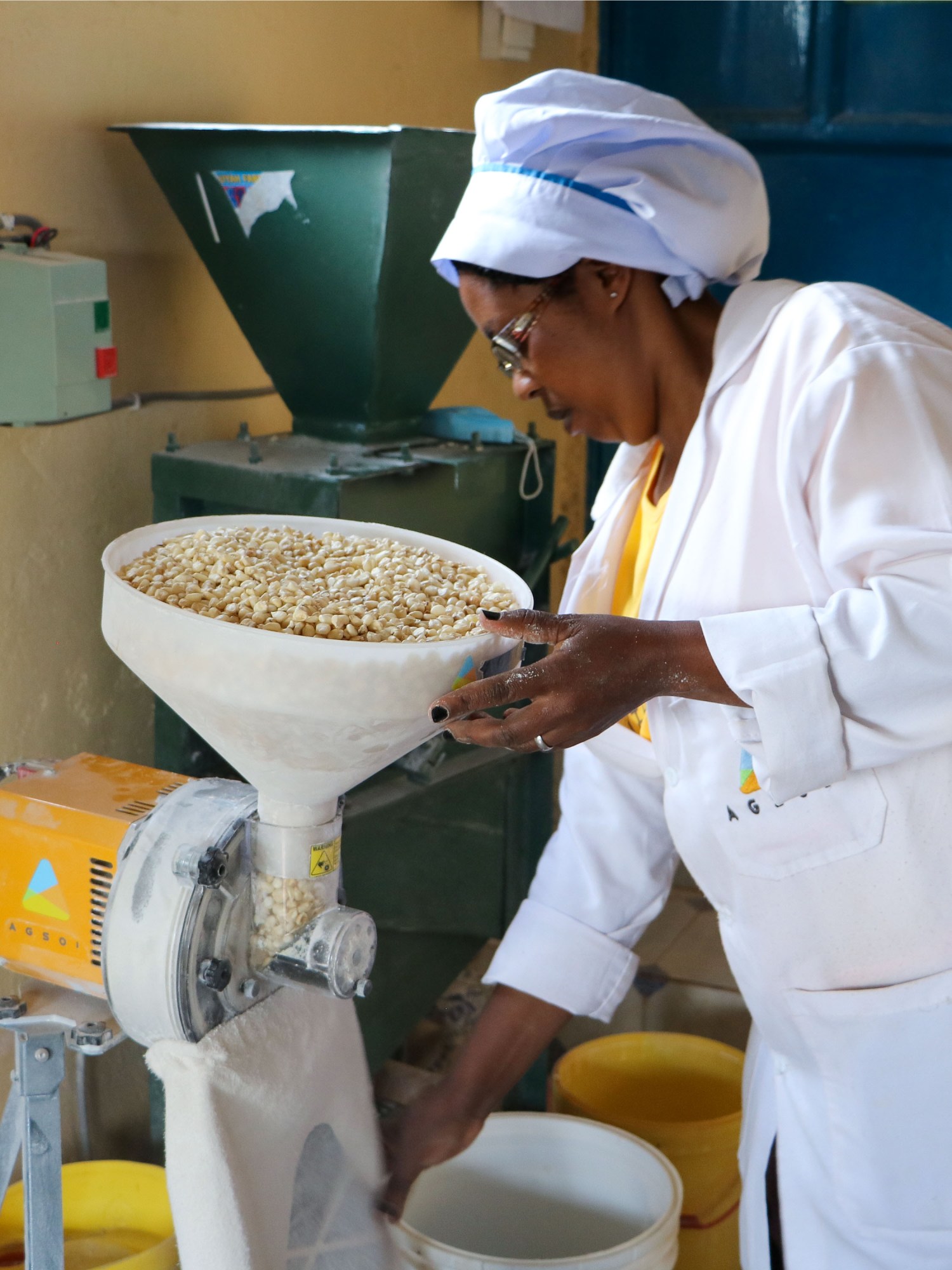
Milcah Wanjiru feeds grains of corn into the Agsol milling machine in her shop.
GEOFFREY KAMADI
__________________________ THE PLACE Nairobi, Kenya
Most of Kenya’s power grid runs on renewables. But with 25% of communities lacking centralized electricity, the nation is looking to off-grid solar to hit its goal of delivering universal electricity access by 2030 without driving up emissions. The ever-improving economics of solar technology have helped. A couple of years ago, a panel cost about $3 a watt; now it’s down to cents.
On the margins of a bustling Nairobi, we wind past a mix of high-rises and hardware shops interspersed with small plots growing corn or potatoes. After a few minutes, we arrive at a street-side stall run by the bespectacled Milcah Wanjiru. She sells plenty of half-liter packets of milk, loaves of bread, and matches, but Wanjiru’s core business is a service: She mills corn flour for local residents, which they most often use in ugali—a common Kenyan dish that is similar to polenta, albeit less creamy.
Advertisement
In the middle of her small shop, a milling machine stands on three adjustable legs. “Whenever customers came to mill their grain, they asked for other goods,” says Wanjiru, “and this is how I got to stock these other items.”
This story is only available to subscribers.
Don’t settle for half the story.
Get paywall-free access to technology news for the here and now.
Shops with a grain mill are common here in rural areas and most neighborhoods, especially low-income ones—even in the city. But most of these mills burn diesel fuel. Hers? It runs on either solar energy or electricity from the grid.
Matt Carr, the CEO and cofounder of Agsol, the company that designed Wanjiru’s mill, is here with me, visiting to get her feedback on his product. One issue bothers her. “It can be slow,” Wanjiru tells Carr, explaining that grains can get stuck in the front chamber where they feed into the machine. Sometimes, the whole thing jams.
Carr says the mill automatically reduces its speed if the grain is at all damp, so that the pulverizing hammers within can squeeze out as much flour as possible. That process can unfortunately lead to the problem she’s describing.
Overall, Wanjiru seems happy with the machine, which she’s been using since December 2025. It makes running her business cheaper. About 40% of what shop owners who use diesel-powered mills charge customers goes toward paying for fuel, according to Carr, whereas operating Agsol’s solar-powered machine can be up to 80% more profitable once the initial cost (about $1,300) is paid off, which takes between six and 12 months. Wanjiru also likes the fact that—unlike diesel-burning models—her mill can handle very small amounts of grain, which has brought a few new customers her way.
Carr launched the first Agsol product in 2018 in Kenya and has raised over $4 million of investment—much of that via a UK government program that supports clean energy projects in the region. Last year, Agsol sold 530 units. The company, which is based just outside Nairobi, has received orders from as far as Mozambique and Angola.
As we say goodbye to Wanjiru, she turns and bends over burlap sacks half full of peanuts, mung beans, rice, and millet, arranged neatly on wooden pallets on the cement floor. She lifts a scoopful from one of the sacks and dumps its contents on a scale. A customer waits to be served.
Geoffrey Kamadi is an award-winning freelance journalist based in Nairobi, focusing on science, climate change, environment, technology, and development.